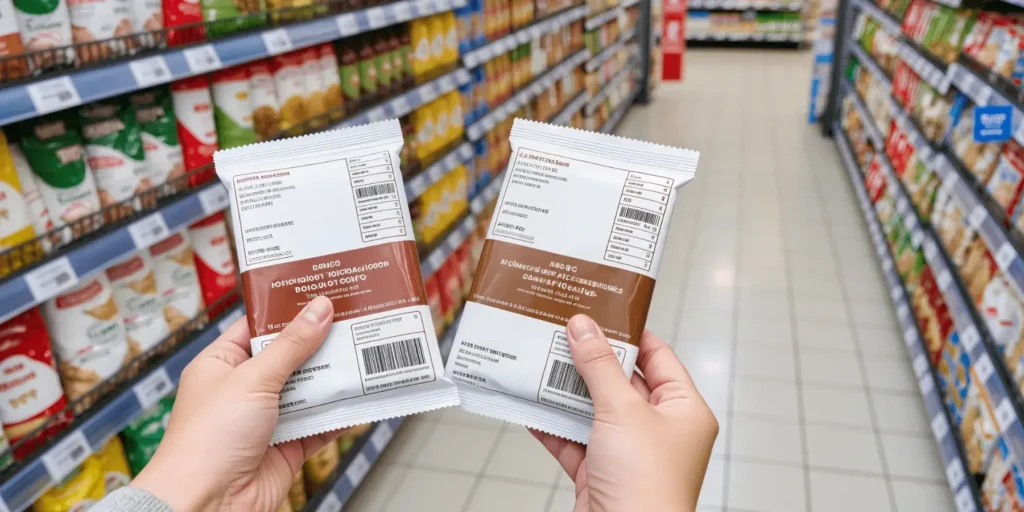
Grocery shopping can feel overwhelming to many health-conscious readers who want to feed their families well without wading through confusing labels. You’re familiar with the bright lights, the heightening energy, and the sense that everyone is rushing to get food and go home quickly.
I understand this feeling. Before I was married and had children, these grocery trips felt more leisurely.
But now, it’s different. The family needs nutrition and nourishment. And we are living in unprecedented times.
There are ingredients on food labels I have never seen before. Even the vague terms I noticed when younger still appear.
But I am more aware now. I am buying food for my children.
Before, I would just avoid certain ingredients. Now my awareness is heightened.
I have been noticing a trend in the wrong direction for the last decade. Ingredient lists read more like a science project than a grocery list.
That’s why I created a 30-second scan method. I’ll show you how to spot seven harmful additives fast. No confusion. No overwhelm. Just clarity.
The 30-Second Label Scan Method
You don’t need a nutrition degree to read a food label. You just need a system. Here’s my 30-second scan method that works every time. For more practical nutrition ideas, see the best caffeine-free mushroom drinks for natural focus.
Step 1: Check the First Five Ingredients
The first five ingredients make up most of the product. If you see red flags here, put it back. The order matters.
Step 2: Scan for “The 7”
Look for the seven additives we’ll cover next. These are concerning additives. If you spot even one, skip it.
Step 3: Count Total Ingredients
More than 10 ingredients? Be cautious. Real food doesn’t need that many. An apple has one ingredient: apple.
Step 4: Look for Vague Terms
Watch for “natural flavors,” “spices,” or “artificial flavors.” These hide what’s really inside. Companies use them to avoid transparency.
Your Decision:
- Keep = Clean ingredients, nothing suspicious
- Unsure? Research it later
- Skip = Red flags present, not worth the risk
This takes 30 seconds once you practice. Let’s look at those seven additives now.
The 7 Additives to Avoid
- Red 40 (Allura Red AC)
- Yellow 5 (Tartrazine)
- Yellow 6 (Sunset Yellow)
- BHA & BHT (Butylated Hydroxyanisole & Butylated Hydroxytoluene)
- TBHQ (Tertiary Butylhydroquinone)
- Sodium Benzoate (especially with Vitamin C)
- Sodium Nitrite & Sodium Nitrate
Why Avoid These Additives
1. Red 40 (Allura Red AC)
- What it does: Makes food bright red or pink
- Health concern: Studies show it damages DNA and causes inflammation in the colon. It also disrupts gut bacteria (Rasouli et al., 2023). Additional research links it to DNA damage in mice (Tsuda et al., 2001), and recent analysis suggests it may be carcinogenic (Hofseth et al., 2024).
- Found in: Fruit snacks, candy, strawberry milk, red Gatorade, cake mixes
2. Yellow 5 (Tartrazine)
- What it does: Creates bright yellow and orange colors
- Health concern: Linked to hyperactivity and attention problems in children (Arnold, 2012; McCann et al., 2007; Miller et al., 2022). Some people experience allergic reactions. Multiple studies connect it to behavioral changes.
- Found in: Mac and cheese, chips, yellow candy, sports drinks, pickles
3. Yellow 6 (Sunset Yellow)
- What it does: Creates orange and reddish-orange colors
- Health concern: Similar to Yellow 5, linked to hyperactivity in kids. Can trigger allergic reactions and hives. Research shows behavioral impacts (McCann et al., 2007; Miller et al., 2022).
- Found in: Orange soda, cheese crackers, cereals, orange candy, instant mac and cheese
4. BHA & BHT (Butylated Hydroxyanisole & Butylated Hydroxytoluene)
- What it does: Prevents oils and fats from spoiling
- Health concern: BHA is listed as “reasonably anticipated to be a human carcinogen” by the National Toxicology Program (National Toxicology Program, 2021). Both can disrupt hormones. Research in rats showed carcinogenic effects (Ito et al., 1983).
- Found in: Cereals, chips, butter, frozen meals, chewing gum
5. TBHQ (Tertiary Butylhydroquinone)
- What it does: Preserves processed foods and oils
- Health concern: Causes damage to the liver, kidneys, and nervous system (Khezerlou et al., 2022). Research shows it’s toxic to cells and may increase cancer risk (Esazadeh et al., 2024).
- Found in: Crackers, microwave popcorn, frozen pizza, chicken nuggets, cooking oils
6. Sodium Benzoate (especially with Vitamin C)
- What it does: Prevents mold and bacteria growth
- Health concern: When combined with Vitamin C (ascorbic acid), it can form benzene, a known carcinogen. This reaction happens in acidic drinks.
- Found in: Soda, juice drinks, salad dressing, pickles, condiments
7. Sodium Nitrite & Sodium Nitrate
- What it does: Preserves meat and gives it a pink color
- Health concern: When heated or digested, these form compounds called nitrosamines, which are carcinogenic. Large study linked them to increased cancer risk (Chazelas et al., 2022).
- Found in: Bacon, hot dogs, deli meat, sausage, ham, pepperoni
Your First Swaps – Better Alternatives
You don’t have to overhaul your entire pantry today. Start with these simple swaps. Each one removes harmful additives while keeping meals your family enjoys.
These swaps avoid the seven noteworthy additives. They’re not perfect and may contain other processed ingredients, but they’re better choices. This is about reducing harm, not perfection. Always read labels yourself. For more nutrition ideas, see the 15 Best Foods for Healthy Hair Growth.
BREAKFAST
- X SKIP: Kraft Easy Mac (contains Yellow 5 & 6)
- BUY: Annie’s Organic Mac & Cheese (no artificial dyes)
- X SKIP: Pop-Tarts (contains Red 40, TBHQ)
- BUY: Nature’s Path Toaster Pastries (clean ingredients)
SNACKS
- X SKIP: Doritos (contains Yellow 5, Yellow 6, Red 40)
- BUY: Siete Grain-Free Chips (vegetable-based colors only)
- X SKIP: Skittles (contains Red 40, Yellow 5 & 6)
- BUY: YumEarth Organic Fruit Snacks (fruit and vegetable juices for color)
DRINKS
- X SKIP: Sunny D (contains Yellow 5, Yellow 6)
- BUY: Simply Orange Juice (just oranges)
- X SKIP: Gatorade (contains Red 40, Yellow 5)
- BUY: Harmless Harvest Coconut Water (natural electrolytes)
MEATS
- X SKIP: Oscar Mayer Bologna (contains Sodium Nitrite)
- BUY: Applegate Naturals Deli Meat (no nitrates or nitrites)
- X SKIP: Hormel Pepperoni (contains Sodium Nitrite, BHA)
- BUY: Applegate Naturals Pepperoni (uncured, no preservatives)
YOUR ACTION PLAN
You have what you need to begin avoiding harmful additives.
Here’s what you learned:
- A 30-second label scan method
- Seven additives to always avoid
- Better alternatives you can buy today
Your action steps this week:
- Print the list above and keep it with you.
- Check 5 products in your pantry for the seven additives.
- Pick ONE category to swap (breakfast, snacks, drinks, or meats).
- Make ONE swap on your next grocery trip.
- Add one more swap each week.
Small changes add up. You’re protecting your family one swap at a time.
No confusion. No overwhelm. Just clarity at the grocery store.
Your family’s health is worth it.
Want to dive deeper into what’s really in your food? We investigate additives and nutrition transparency at NutraDetective.com. Let’s keep learning together.
For a broader view on nutrition and preventive health, see How Early Detection and Preventive Care Reduce Cancer Risk.
Printable Grocery List: The 7 Additives to Always Avoid
SAVE OR PRINT THIS LIST:
- Red 40 (Allura Red AC)
- Yellow 5 (Tartrazine)
- Yellow 6 (Sunset Yellow)
- BHA & BHT (Butylated Hydroxyanisole & Butylated Hydroxytoluene)
- TBHQ (Tertiary Butylhydroquinone)
- Sodium Benzoate (especially with Vitamin C)
- Sodium Nitrite & Sodium Nitrate
For more nutrition ideas, see our guide on 15 Best Foods for Healthy Hair Growth.
REFERENCES
- Arnold, L. E., et al. (2012). Artificial colors and attention-deficit/hyperactivity symptoms: Conclusions to dye for. Neurotherapeutics, 9(3), 599-609. https://pmc.ncbi.nlm.nih.gov/articles/PMC3441937/
- Chazelas, E., et al. (2022). Nitrites and nitrates from food additives and natural sources and cancer risk.
- International Journal of Epidemiology, 51(4), 1106-1119. https://doi.org/10.1093/ije/dyac046/
- Esazadeh, S., et al. (2024). Exploring the cytotoxic effects of tert-butylhydroquinone (TBHQ). Toxicology Reports, 12, 340-348. https://doi.org/10.1016/j.toxrep.2024.02.007
- Hofseth, L. J., et al. (2024). Allura Red AC is a xenobiotic. Is it also a carcinogen? Carcinogenesis, 45(10), 711-
720. https://pmc.ncbi.nlm.nih.gov/articles/PMC11464682/ - Ito, N., et al. (1983). Carcinogenicity of butylated hydroxyanisole in F344 rats. Journal of the National Cancer Institute, 70(2), 343-352.
- Khezerlou, A., et al. (2022). Neurotoxicity, hepatotoxicity, nephrotoxicity, and carcinogenicity of tert- butylhydroquinone. Toxicology Research, 11(4), 647-659. https://doi.org/10.1093/toxres/tfac036
- McCann, D., et al. (2007). Food additives and hyperactive behaviour in 3-year-old and 8/9-year-old children.
Lancet, 370(9598), 1560-1567. - Miller, M. D., et al. (2022). Potential impacts of synthetic food dyes on activity and attention in children. Environmental Health, 21(1), 45. https://pmc.ncbi.nlm.nih.gov/articles/PMC9052604/
- National Toxicology Program. (2021). Report on Carcinogens, Fifteenth Edition: Butylated Hydroxyanisole. U.S. Department of Health and Human Services. https://www.ncbi.nlm.nih.gov/books/NBK590883/
- Rasouli, O., et al. (2023). The synthetic food dye, Red 40, causes DNA damage, causes colonic inflammation,
and impacts the microbiome in mice. Nature Communications, 14(5758). https://pmc.ncbi.nlm.nih.gov/articles/PMC10502305/ - Tsuda, S., et al. (2001). DNA damage induced by red food dyes orally administered to pregnant and male mice. Toxicological Sciences, 061(1), 92-99.
About the Author
Ahnjonee Turner is co-founder of NutraDetective and co-author of the Eden Health Guide. In 2013, she developed mysterious food allergies that medical tests couldn’t explain. Through extensive research and working with a holistic doctor, she uncovered a shocking truth about what was really making her sick.
Discover her full story in the Eden Health Guide.
Visit NutraDetective.com
For additional nutrition guidance, see our 15 Best Foods for Healthy Hair Growth article.