You slept for eight hours last night. Maybe nine. And yet here you are, sitting on the edge of the bed at 7am, feeling like you barely closed your eyes. The alarm felt like an assault. The coffee is not helping the way it used to. And the exhaustion that should have lifted by mid-morning is still sitting in your bones by the time you are trying to get through the afternoon.
If this is your most mornings — not occasionally, not after a bad night, but consistently, week after week, month after month — then the problem is almost certainly not how long you are sleeping. It is what is happening to your body during those hours.
And the most likely cause is one that the majority of people reading this article have never been tested for.
What Is Sleep Apnea — and Why Is It So Commonly Missed?
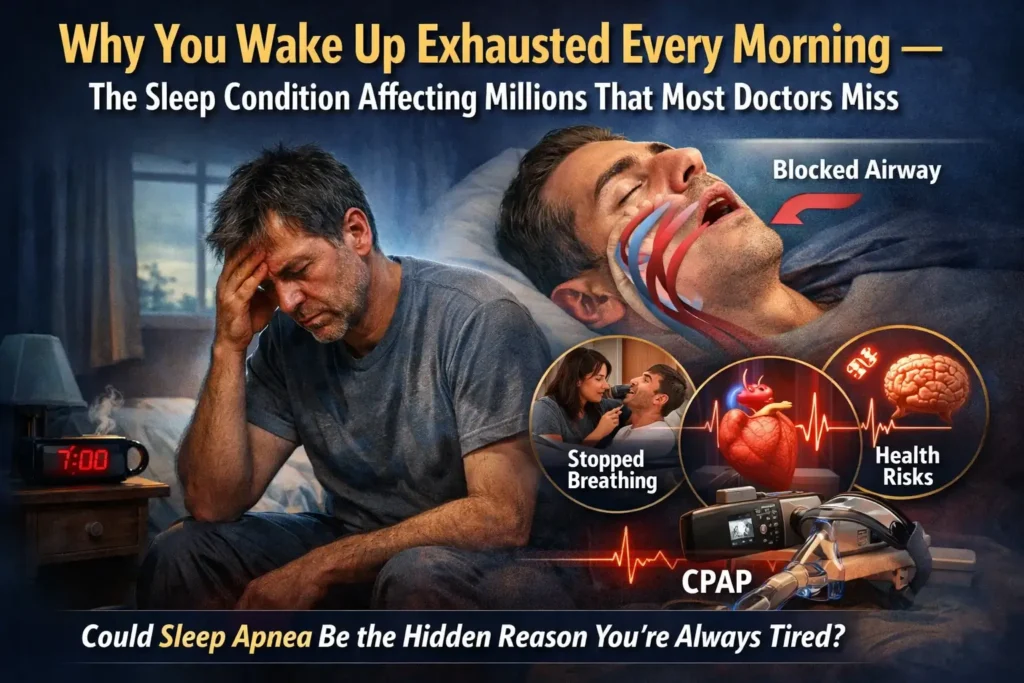
Obstructive sleep apnea (OSA) is a medical condition in which the muscles of the throat relax during sleep, causing the upper airway to collapse and block normal breathing. When this happens, breathing temporarily stops — sometimes for 10 seconds, sometimes for 30 or more. The brain detects the drop in oxygen, triggers a brief arousal to restart breathing, and the cycle begins again.
This can happen five times per hour. It can happen 50 times per hour. It can happen more than 100 times across a single night — and the person experiencing it typically has no memory of any of it in the morning.
According to research published in the journal The Lancet Respiratory Medicine, obstructive sleep apnea affects an estimated 936 million adults worldwide. In the United Kingdom alone, approximately 1.5 million adults have clinically significant OSA — and studies consistently show that around 85 percent of those cases are undiagnosed.
The reason it is missed so frequently is straightforward: it does not show up on a standard blood test. It does not produce a reading that a GP can identify at a morning appointment. The only way to find it is to measure what happens to a person’s breathing and oxygen levels during sleep — which requires a sleep study that most routine clinical pathways do not include as a first step.
The Signs That Something Is Wrong With Your Sleep
Many people with undiagnosed sleep apnea attribute their symptoms to stress, age, poor lifestyle habits or simply being “not a morning person.” The symptoms are real and recognisable, but they are easy to explain away individually. Together, they form a pattern worth taking seriously.
Morning Symptoms
Waking unrefreshed regardless of sleep duration is the most consistent and defining symptom of obstructive sleep apnea. Unlike the tiredness of a poor night’s sleep, which typically improves with a good night’s rest, the exhaustion of sleep apnea persists because the underlying sleep architecture — the cycles of deep, restorative sleep the body needs — is being fragmented every night.
Morning headaches, particularly at the back of the head, are caused by elevated carbon dioxide levels that build up when breathing is repeatedly disrupted during the night. These headaches typically resolve within an hour or two of waking.
Dry mouth upon waking is a sign that the body has been compensating for nasal airway obstruction during sleep by breathing through the mouth.
Daytime Symptoms
Excessive daytime sleepiness — not ordinary tiredness, but the kind that makes it difficult to stay alert during meetings, while driving or in the middle of tasks that require concentration — is one of the most clinically significant warning signs of sleep-disordered breathing.
Difficulty concentrating and poor memory reflect the impact of chronic sleep fragmentation on the prefrontal cortex — the area of the brain most responsible for cognitive function and most sensitive to sleep deprivation.
Mood changes, irritability and low mood are commonly reported by people with undiagnosed OSA and frequently lead to antidepressant prescriptions that address the downstream consequences while the root cause continues operating overnight.
Sleep-Related Symptoms
Loud snoring — particularly snoring that includes pauses, followed by gasping or snorting — is one of the most recognisable external signs of obstructive sleep apnea. The snoring is produced by turbulent air moving through a partially obstructed airway, and the pauses represent the complete obstruction of an apnea event.
Witnessed apneas — moments where a bed partner has noticed breathing stopping during sleep — are among the most clinically specific symptoms of OSA and warrant immediate investigation.
Waking gasping or with a pounding heart is often attributed to anxiety or vivid dreams but frequently reflects a full arousal triggered by a significant oxygen drop during a severe apnea event.
Why Untreated Sleep Apnea Is a Serious Health Concern
Sleep apnea is not simply a sleep quality issue. Untreated obstructive sleep apnea has been linked to a range of serious health conditions in peer-reviewed research spanning several decades.
A study published in the Journal of Clinical Sleep Medicine found that patients with obstructive sleep apnea had significantly elevated rates of hypertension, cardiovascular disease and metabolic syndrome compared to matched controls. The mechanism involves the repeated nocturnal oxygen drops and stress hormone surges — cortisol and adrenaline — that each apnea event produces. Over months and years, these surges damage blood vessels, elevate resting blood pressure and increase cardiovascular risk in ways that accumulate silently.
Research published by the American Heart Association has documented associations between untreated OSA and increased risk of stroke, atrial fibrillation and heart failure. The European Respiratory Journal has reported on the relationship between sleep apnea and metabolic conditions including type 2 diabetes.
Beyond cardiovascular risk, emerging research in neuroscience has shown that chronic untreated sleep apnea is associated with structural changes in the brain — particularly in the hippocampus and prefrontal cortex — that are linked to memory impairment and cognitive decline.
These are not minor inconveniences. They are the long-term consequences of a condition that, when identified and treated, responds well to available therapies.
How Sleep Apnea Is Diagnosed
The gold standard diagnostic test for obstructive sleep apnea is a sleep study — either an in-laboratory polysomnography, which measures multiple physiological variables overnight in a clinical setting, or a validated home sleep apnea test (HSAT), which uses a portable device worn during sleep at home.
According to the American Academy of Sleep Medicine (AASM), home sleep apnea testing is appropriate for adults with a high pre-test probability of moderate-to-severe obstructive sleep apnea and without significant comorbidities that would require in-lab assessment. Modern FDA-cleared HSAT devices can measure oxygen saturation, breathing events, heart rate and body position with accuracy comparable to in-lab testing for OSA diagnosis.
The result of a sleep study is expressed as the Apnea-Hypopnea Index (AHI) — the average number of breathing disruptions per hour of sleep. An AHI of 5 to 14 indicates mild OSA, 15 to 29 indicates moderate, and 30 or above indicates severe obstructive sleep apnea.
If you suspect you may have sleep apnea based on the symptoms above, the appropriate first step is to discuss this specifically with your GP and request a referral for a sleep study.
Treatment Options for Obstructive Sleep Apnea
CPAP Therapy
Continuous Positive Airway Pressure (CPAP) therapy is the most widely used and most effective treatment for moderate-to-severe obstructive sleep apnea. A CPAP machine delivers a continuous stream of pressurised air through a mask worn during sleep, maintaining enough airway pressure to prevent collapse and eliminate apnea events.
Research consistently shows that effective CPAP therapy improves sleep quality, reduces daytime sleepiness, lowers blood pressure and reduces cardiovascular risk in patients with OSA. Most patients notice improvements in sleep quality within the first week of use.
Lifestyle Modifications
For patients with mild OSA or as an adjunct to other treatments, several lifestyle changes have evidence supporting their effectiveness.
- Weight management is one of the most impactful modifiable factors in sleep apnea.
- Positional therapy — avoiding sleeping on the back — can reduce apnea severity.
- Reducing alcohol consumption before sleep can prevent airway relaxation.
Oral Appliance Therapy
Mandibular advancement devices — custom-fitted dental appliances that reposition the jaw during sleep to maintain airway patency — are effective for mild-to-moderate OSA and offer an alternative for patients who cannot tolerate CPAP.
Medical Therapies
In June 2024, tirzepatide (Zepbound) became the first medication approved by the U.S. Food and Drug Administration specifically for the treatment of obstructive sleep apnea in adults with obesity following the SURMOUNT-OSA clinical trial.
When to Seek Help
If you regularly wake up feeling unrefreshed, snore loudly, have been told you stop breathing during sleep, or experience significant daytime sleepiness, these symptoms warrant a conversation with a healthcare professional about sleep apnea assessment.
The STOP-BANG questionnaire — a validated screening tool used by clinicians worldwide — asks eight questions covering snoring, tiredness, observed apneas, blood pressure, BMI, age, neck circumference and gender.
You do not have to accept exhaustion as your baseline. If your sleep is not restoring you, it is worth finding out why.
References
- Benjafield AV, et al. Estimation of the global prevalence and burden of obstructive sleep apnoea. The Lancet Respiratory Medicine. 2019.
- Punjabi NM. The epidemiology of adult obstructive sleep apnea. Proceedings of the American Thoracic Society. 2008.
- Somers VK, et al. Sleep apnea and cardiovascular disease. Circulation. 2008.
- Muraki I, et al. Sleep apnea and type 2 diabetes. Journal of Diabetes Investigation. 2018.
- Macey PM, et al. Brain morphology associated with obstructive sleep apnea. American Journal of Respiratory and Critical Care Medicine. 2002.
- Kapur VK, et al. Clinical practice guideline for diagnostic testing for adult obstructive sleep apnea. Journal of Clinical Sleep Medicine. 2017.
- Giles TL, et al. Continuous positive airway pressure for obstructive sleep apnoea in adults. Cochrane Database of Systematic Reviews. 2006.
- Peppard PE, et al. Longitudinal association of sleep-related breathing disorder and depression. Archives of Internal Medicine. 2006.
- Malhotra A, et al. Tirzepatide for the treatment of obstructive sleep apnea. New England Journal of Medicine. 2024.