
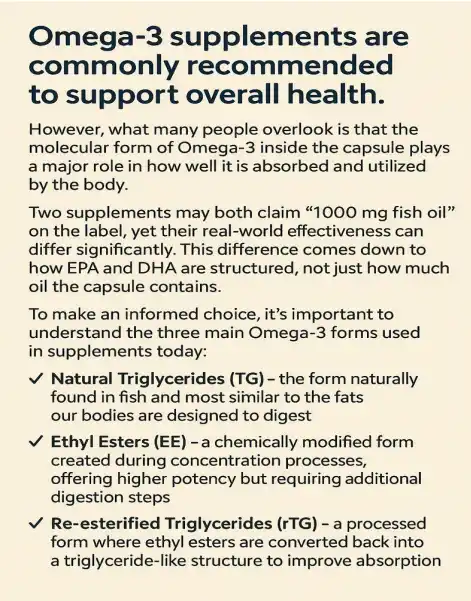
Omega-3 supplements are commonly recommended to support overall health. However, what many people overlook is that the molecular form of Omega-3 inside the capsule plays a major role in how well it is absorbed and utilized by the body.
Two supplements may both claim “1000 mg fish oil” on the label, yet their real-world effectiveness can differ significantly. This difference comes down to how EPA and DHA are structured, not just how much oil the capsule contains.
To make an informed choice, it’s important to understand the three main Omega-3 forms used in supplements today:
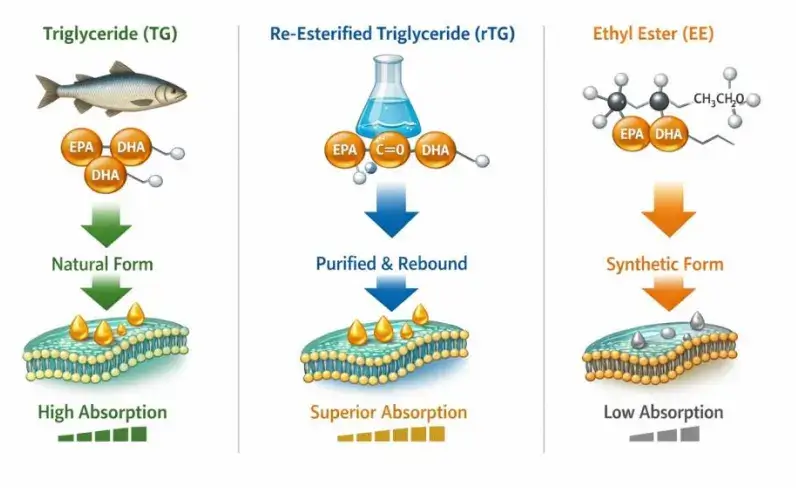
- Natural Triglycerides (TG) – the form naturally found in fish and most like the fats our bodies are designed to digest.
- Ethyl Esters (EE) – a chemically modified form created during concentration processes, offering higher potency but requiring additional digestion steps.
- Re-esterified Triglycerides (rTG) – a processed form where ethyl esters are converted back into a triglyceride-like structure to improve absorption.
Understanding these forms helps explain why not all fish oil supplements deliver the same benefits, even when the numbers on the label look identical.
Let’s explore how each Omega-3 form is produced, how the body processes it, and why natural triglycerides — particularly purified rTG — are widely regarded as the most effective option.
Natural Triglycerides (TG): The Form Found in Fish
In fish, Omega-3 fatty acids naturally exist in the triglyceride (TG) form, made up of: One glycerol molecule, three fatty acids (such as EPA, DHA, or other fats)
When fish oil is gently extracted without aggressive chemical processing, it retains this original TG structure. This is the form the human body is most familiar with and can absorb efficiently.
Benefits of Natural TG
- High bioavailability — readily absorbed and transported to tissues
- Gentle digestion — no additional enzymatic conversion required
- Natural structure — identical to the dietary fats our bodies process every day
Limitation
Lower EPA/DHA concentration before further purification
In essence, natural TG is biologically ideal, but it often requires additional refinement to enhance purity and increase Omega-3 potency.
Ethyl Esters (EE): A Processed Form Created During Purification
To produce highly concentrated Omega-3 oils and remove unwanted contaminants such as heavy metals, PCBs, dioxins, and other marine pollutants, manufacturers must first break the natural triglyceride structure found in fish oil. During this purification process, the fatty acids (EPA and DHA) are chemically detached from glycerol and temporarily bonded to ethanol, creating what is known as Ethyl Ester (EE) Omega-3.
This processing step allows manufacturers to achieve higher EPA and DHA concentrations, which can make supplement labels appear more potent. However, ethyl esters are not a form that naturally occurs in food or in the human body. As a result, EE Omega-3 must undergo additional digestive and enzymatic conversion before it can be absorbed and used.
Because of this extra metabolic step, ethyl ester Omega-3 is absorbed less efficiently than natural triglyceride (TG) or re-esterified triglyceride (rTG) forms, particularly in individuals with reduced digestive capacity. While EE offers manufacturing and cost advantages, it is generally considered biologically less optimal compared with triglyceride-based Omega-3 formulations.
Limitations of Ethyl Ester (EE) Omega-3
- Requires Conversion to Triglycerides (TG): Ethyl ester omega-3 must first be converted back into triglyceride form before the body can use it. This extra metabolic step reduces overall absorption efficiency.
- Depends on Digestive Enzymes: Proper absorption requires sufficient bile acids and pancreatic enzymes. Absorption may be reduced in older adults or individuals with digestive disorders.
- Less Stable During Digestion: EE omega-3 is more prone to breakdown in the digestive tract, which can cause fishy aftertaste, reflux, or burping.
- Must Be Taken with Fatty Meals: Absorption is highly dependent on dietary fat. If taken without a fatty meal, effectiveness drops significantly.
- Lower Bioavailability: Multiple clinical studies show that ethyl ester omega-3 has lower bioavailability compared with natural triglyceride (TG) and re-esterified triglyceride (rTG) forms.
Why Is the EE Form Still Widely Used?
Cost and scalability. Ethyl esters are cheaper and easier to manufacture in large volumes, which is why they are commonly found in lower-priced Omega-3 supplements.
TG vs rTG — Are They the Same?
TG (Natural Triglyceride)
Natural triglyceride (TG) is the form of omega-3 that occurs naturally in fish. It maintains the original triglyceride structure that the human body is designed to recognize and digest. The purity of TG omega-3 depends largely on the quality of the fish source and the care taken during extraction.
EPA and DHA levels are typically moderate, as minimal processing is used to preserve the natural structure. Label information may sometimes be unclear, as products do not always specify whether the omega-3 is in natural TG form. Despite this, TG omega-3 offers high bioavailability and is efficiently absorbed by the body.
rTG (Re-esterified Triglyceride)
Re-esterified triglyceride (rTG) is a more advanced form of omega-3 that is created by rebuilding the triglyceride structure after purification. This process allows manufacturers to remove contaminants while restoring the natural fat structure the body prefers.
As a result, rTG omega-3 achieves pharmaceutical-grade purity with higher and more concentrated levels of EPA and DHA. Products containing rTG typically state “Re-esterified TG” clearly on the label. Among all omega-3 forms, rTG provides the highest bioavailability, combining excellent absorption with superior purity and potency.
Both TG and rTG are triglyceride forms
rTG is the optimized version, combining the natural structure of TG with higher purity and potency, making it the clinically superior choice.
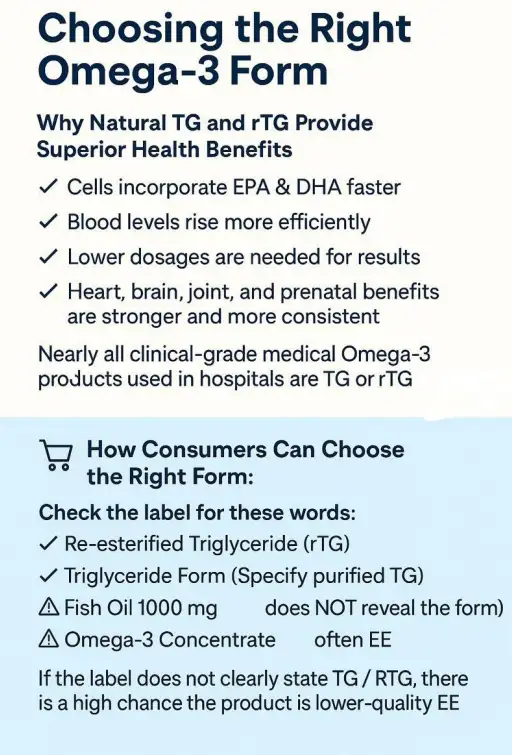
Why Natural TG and rTG Provide Superior Health Benefits
- When Omega-3 is delivered in a form the body naturally recognizes and uses: EPA and DHA are absorbed and incorporated into cells more rapidly
- Blood Omega-3 levels increase more efficiently
- Lower doses are needed to achieve measurable benefits
- Health effects on the heart, brain, joints, and during pregnancy are more reliable and consistent
For this reason, clinical-grade Omega-3 formulations used in medical and hospital settings are almost always in TG or rTG form — not ethyl esters (EE).
How Consumers Can Choose the Right Omega-3 Form
When reading a supplement label, look for these clear identifiers:
✔ “Re-esterified Triglyceride (rTG)”
✔ “Triglyceride Form” (ideally specified as purified TG)
Be cautious of vague or misleading terms:
⚠ “Fish Oil 1000 mg” — does not disclose the Omega-3 form
⚠ “Ethyl Ester Form”
⚠ “Omega-3 Concentrate” — often indicates EE
If a label does not clearly state TG or rTG, there is a strong likelihood that the product contains lower-quality ethyl ester Omega-3.
The form matters just as much as the dose. Choosing TG or rTG ensures better absorption, greater efficiency, and more dependable health benefits.
Conclusion
Not all omega-3 supplements deliver the same physiological benefits, even when their labels appear similar. While many products prominently display “1000 mg fish oil,” this number alone does not reflect how much EPA and DHA the body can actually absorb and use. The molecular form of omega-3 fatty acids plays a decisive role in digestion, transport, cellular uptake, and ultimately, clinical effectiveness.
In nature, omega-3 fatty acids exist as natural triglycerides (TG)—the same fat structure found in whole fish and the form the human digestive system has evolved to recognize and process efficiently. Because this structure aligns with normal fat metabolism, TG omega-3 is readily absorbed and incorporated into tissues.
Re-esterified triglycerides (rTG) build upon this biological advantage by restoring the triglyceride structure after purification. This allows for higher EPA and DHA concentrations while maintaining excellent absorption, resulting in the highest bioavailability and pharmaceutical-grade purity available in omega-3 supplements.
By contrast, ethyl ester (EE) omega-3s are a chemically modified form created during intensive purification. Although EE products often offer higher label potency and lower manufacturing costs, they require additional enzymatic conversion back into triglycerides before the body can use them.
This extra metabolic step consistently leads to reduced absorption efficiency, greater dependence on digestive enzymes and dietary fat, and a higher likelihood of gastrointestinal discomfort.
For consumers, clinicians, and health-conscious individuals, understanding these molecular differences is critical. Choosing omega-3 supplements in TG or rTG form ensures more reliable absorption, more predictable health outcomes, and greater biological value per milligram consumed—rather than relying on label numbers alone.
When it comes to omega-3 supplementation, form matters just as much as dose. Selecting the correct molecular structure—preferably natural TG or rTG—is essential for unlocking the true benefits of EPA and DHA and achieving meaningful, long-term health results.
