Introduction: Understanding Skin’s Structural Foundation
Healthy skin is not defined by appearance alone. It reflects the condition of a highly organized biological system in which structural support, hydration, cellular signaling, and extracellular matrix integrity all work together. Among the most extensively studied components of this system are collagen and hyaluronic acid (HA), two molecules that play distinct yet interconnected roles in skin physiology.
Rather than functioning independently, collagen and hyaluronic acid operate within the same extracellular environment, where they help maintain the structure and hydration balance of the skin. Understanding how these molecules interact, and why proportion matters, provides a more scientifically grounded perspective on skin health than focusing on either one in isolation.
Collagen: The Structural Protein of the Dermis
Collagen is the most abundant protein in the human body, accounting for roughly 30% of total protein content. In the skin, Type I collagen is the predominant form and serves as a major source of tensile strength and mechanical support within the dermis.
Its role is foundational. Collagen contributes to structural integrity, supports dermal thickness, helps maintain firmness and elasticity, and provides a scaffold that supports cellular attachment and tissue organization. Fibroblasts produce collagen and arrange it into an organized extracellular network that gives skin much of its resilience.
Over time, however, collagen synthesis gradually declines, while collagen degradation increases through both intrinsic aging and external stressors such as ultraviolet exposure and oxidative damage. This shift contributes to visible and functional changes in skin architecture.
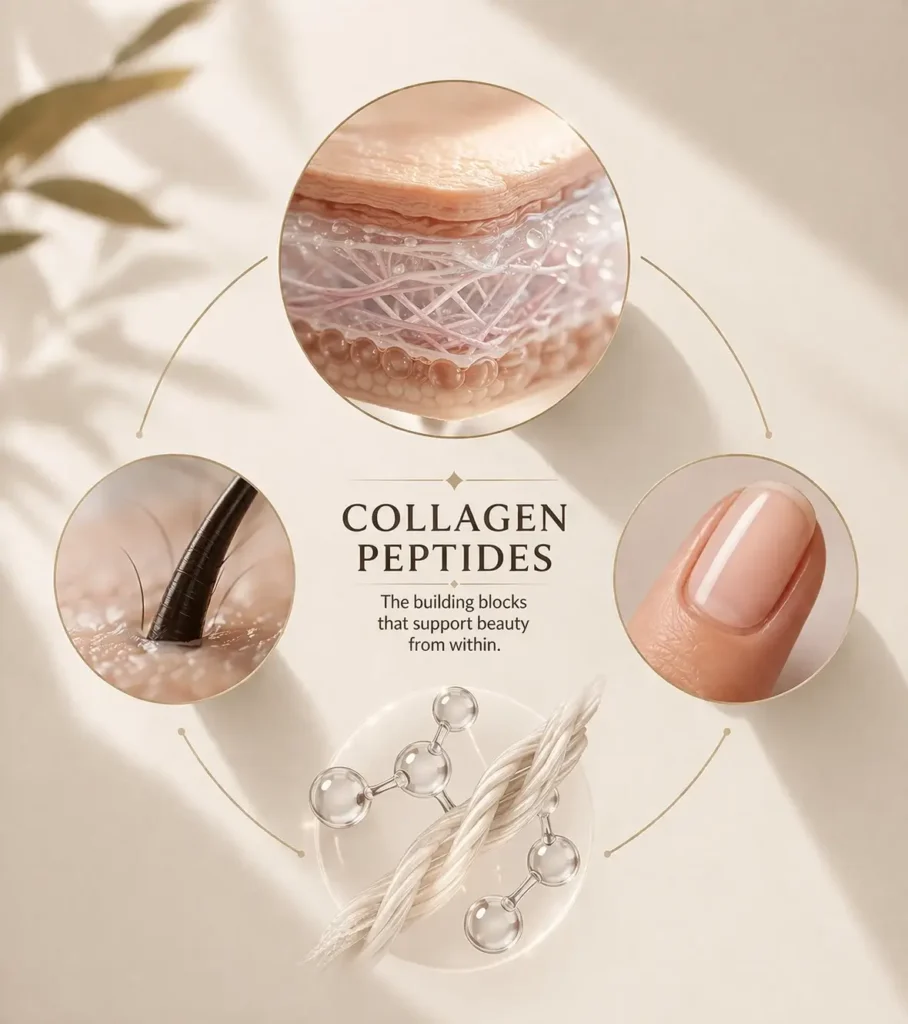
This is one reason collagen remains central to conversations around collagen for skin hair and nails, as these tissues all depend, directly or indirectly, on structural proteins and connective tissue integrity.
Hyaluronic Acid: The Hydration Architect of the Extracellular Matrix
Hyaluronic acid is a naturally occurring glycosaminoglycan found throughout connective tissues, with particularly important roles in the skin and extracellular matrix. Its most recognized property is its remarkable ability to bind water, up to 1,000 times its molecular weight, which allows it to contribute significantly to tissue hydration and viscoelasticity.
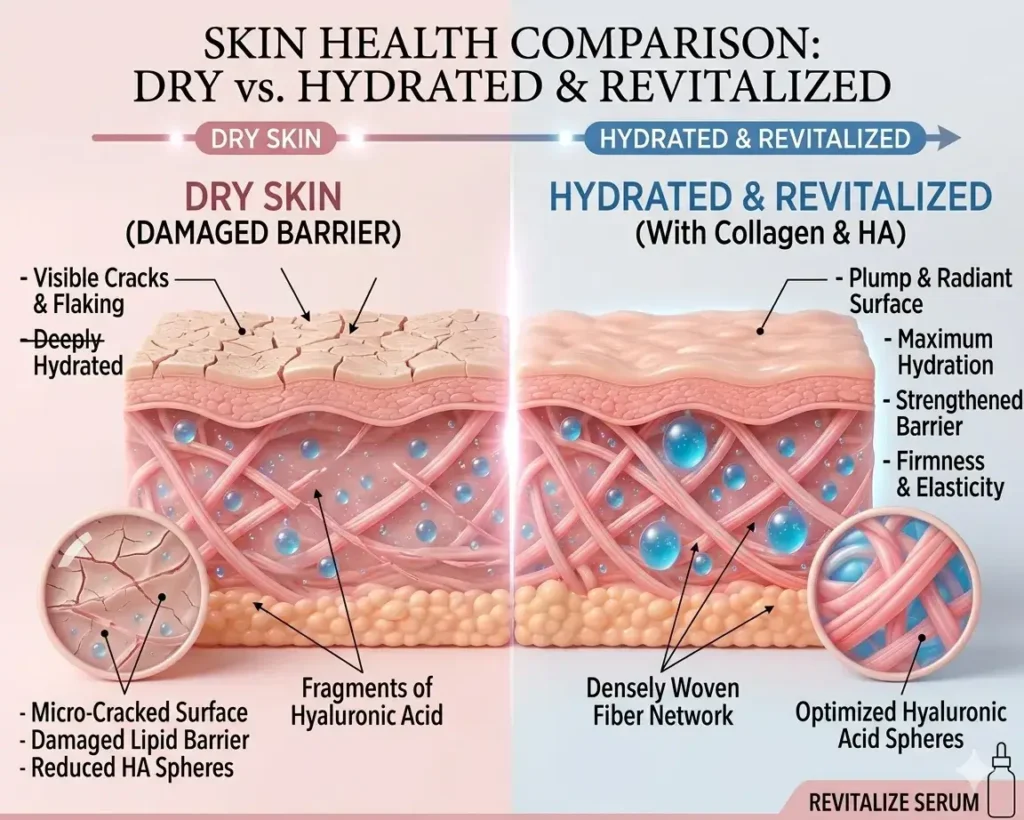
Within the skin, hyaluronic acid helps maintain hydration and turgor, regulates extracellular matrix viscosity, supports nutrient diffusion, facilitates cellular communication, and influences fibroblast activity. In youthful skin, HA forms part of a hydrated matrix surrounding collagen and elastin fibers, helping preserve proper spacing, flexibility, and structural balance.
As HA levels decline with age, the skin may lose some of its hydration efficiency and extracellular matrix quality. This is one reason that scientific interest in hyaluronic acid continues to grow, especially when examined alongside collagen rather than as a separate topic.
The Collagen–Hyaluronic Acid Interaction: A Functional Partnership
Collagen provides the structural framework of the dermis, while hyaluronic acid helps maintain the hydrated environment necessary for that framework to function optimally. The relationship between the two is best understood as complementary rather than interchangeable.
Without adequate hyaluronic acid, collagen fibers may exist in a less hydrated extracellular environment, potentially affecting flexibility, spacing, and nutrient transport within the tissue. At the same time, hydration alone cannot compensate for the absence of structural protein support. Skin depends on both framework and hydration to maintain resilience.
This is why the pairing of collagen peptides and hyaluronic acid has drawn growing attention in skin science and wellness discussions. The combination reflects the biological reality that the skin’s extracellular matrix depends on both mechanical support and moisture regulation. Rather than focusing only on structure or only on hydration, this perspective recognizes the value of supporting both dimensions together.
Scientific evidence increasingly suggests that extracellular matrix homeostasis depends on the dynamic relationship between structural proteins, glycosaminoglycans, and the surrounding cellular environment.
Why the Right Amount Matters
Biological systems function best through balance and regulation, not excess. More is not always better, especially when discussing nutrients and structural molecules that operate within complex physiological systems.
Hydrolyzed collagen peptides have been studied for their absorption and their potential role in supporting fibroblast-related pathways. Similarly, oral hyaluronic acid has been investigated for its relationship to skin hydration and moisture balance. Yet outcomes are influenced by several factors, including dosage, molecular weight, bioavailability, formulation quality, and the broader nutritional context in which these ingredients are used.
A thoughtful approach therefore requires more than simply combining ingredients. It requires understanding how they function, how they are delivered, and how they may complement the body’s existing biological systems.
Aging and Extracellular Matrix Changes
Intrinsic aging and environmental stressors both influence the extracellular matrix over time. Collagen density tends to decline, collagen fibers may become more fragmented, hyaluronic acid concentration may decrease, and the overall organization of the extracellular matrix can become less efficient.
These changes do not reflect a single-molecule problem. They reflect a systems-level shift in skin physiology. Focusing on only one part of the matrix may oversimplify what is actually a coordinated network of structural proteins, hydration molecules, antioxidants, enzymes, and cellular processes.
This broader view is especially useful when discussing healthy aging and skin support, because it places collagen and hyaluronic acid within the context of the full dermal environment rather than presenting them as isolated trends.
A Systems-Based Perspective on Skin Health
Skin physiology depends on cooperation among multiple biological systems. Structural proteins such as collagen, matrix molecules such as hyaluronic acid, fibroblast activity, antioxidant defenses, hydration status, and cellular turnover all influence how skin functions over time.
Supporting both collagen and hyaluronic acid aligns more closely with natural extracellular matrix biology than focusing narrowly on one pathway alone. This is part of why modern discussions of skin wellness increasingly move toward matrix support rather than single-ingredient hype.
It also explains why interest in collagen for skin hair and nails often extends beyond aesthetics. These tissues reflect broader structural and nutritional patterns in the body, and skin in particular depends on the interaction between protein structure and hydration balance.
Conclusion: Balance Over Hype
Collagen provides structural strength, while hyaluronic acid helps maintain hydration and extracellular matrix integrity. Together, they contribute to the architecture and function of healthy skin in a way that is more meaningful than either one alone.
The science continues to evolve, but one principle remains clear: skin health is best understood through balance, not exaggeration. A more responsible and evidence-based perspective recognizes that structural support and hydration are both essential, and that the relationship between them is central to how skin maintains resilience over time.
By viewing collagen and hyaluronic acid as functional partners within the extracellular matrix, we move closer to a more complete understanding of skin physiology and away from the oversimplified language that often dominates the wellness space.
References
- Ricard-Blum S. The collagen family. Cold Spring Harb Perspect Biol. 2011.
- Papakonstantinou E, Roth M, Karakiulakis G. Hyaluronic acid: A key molecule in skin aging. Dermatoendocrinol. 2012.
- Proksch E, Segger D, Degwert J, et al. Oral supplementation of specific collagen peptides improves skin physiology. Skin Pharmacol Physiol. 2014.
- Oe M, et al. Oral hyaluronan relieves wrinkles. Clin Cosmet Investig Dermatol. 2017.